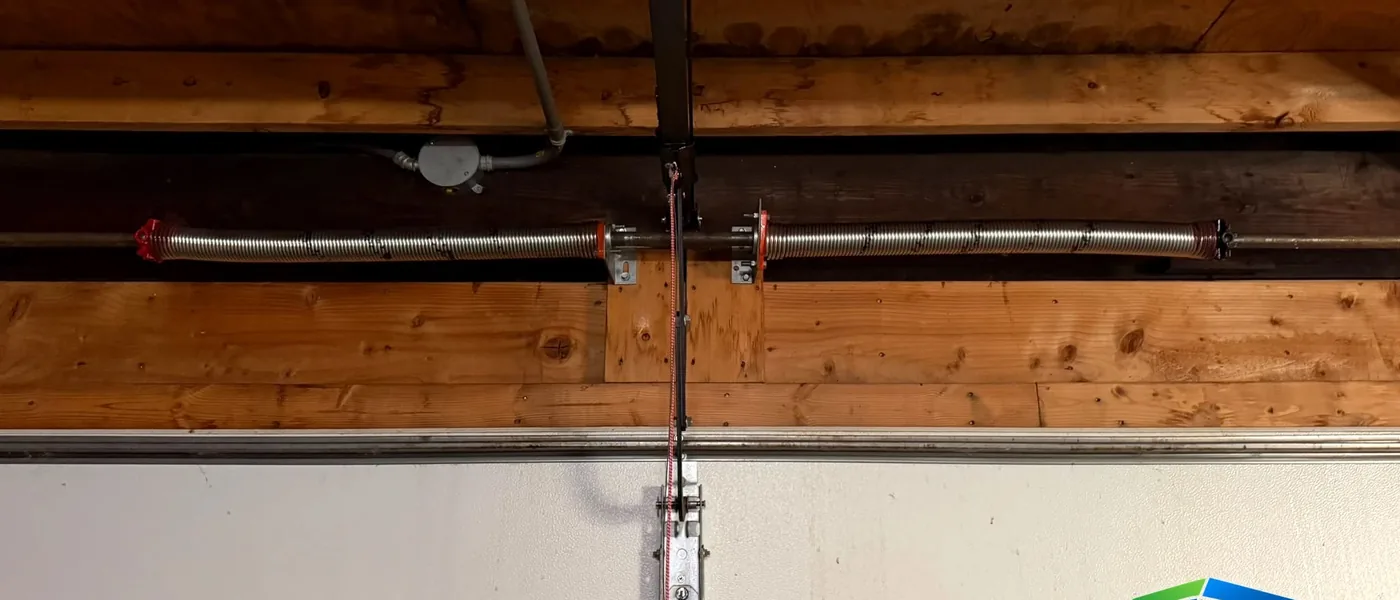
How to tell a spring has broken
Many people hear it before they see it. A torsion spring often breaks with a loud bang, like a firecracker in the garage.
Afterward you may see a gap in the spring on the bar above the door. The door may feel extremely heavy, rise only a few inches, or go up crooked. Sometimes the opener runs and the door barely moves.
Extension springs, which run along the side tracks on some older doors, can also break. You may see a stretched or snapped spring hanging from one side, and the door may tilt as it moves.
Cables can slip off or go slack after a spring breaks, too. Do not try to put them back.
What to do when a garage door spring breaks: stop the opener
Do not keep pressing the button. An opener is designed to guide a balanced door, not to lift its full weight. Running it against a door with a broken spring can strip gears, bend the rail, or pull the door off balance.
If the door is stuck partway, unplug the opener so nobody runs it by accident.
Some openers will try to lift the door and then stop or reverse after a few inches. That is the opener protecting itself. Do not keep trying.
The same goes for anyone else in the house. Tell family members that the door is out of service so nobody presses a remote in the car or the button on the wall. A short note taped over the wall button works well. If you have a smart opener app, turn off remote access until the door is repaired.
Leave the door where it is. A stuck door is an inconvenience. A door that drops while someone tries to free it is a far bigger problem, for the person and for anything underneath.
Be careful with the emergency release
The red emergency release cord disconnects the door from the opener. That is useful when the door is fully closed.
On a door that is partly open, pulling the cord can let it fall. With a broken spring there is nothing holding the weight. Leave the cord alone unless the door is all the way down.
If the door is closed and you need the car, it is safer to leave it in the garage and arrange a ride than to try to open a door with a broken spring. Without the spring, a single section door or a two-car door can weigh far more than one person can safely control.
Keep the door still and stay clear
If the door is partly open, some technicians suggest clamping locking pliers on the track just below the bottom rollers. That helps stop the door from sliding down. Only do this if you can reach the track without standing under the door.
- Keep children, pets and cars out from under the door.
- Do not try to lift the door by hand, alone or with help.
- Do not touch the springs, cables or winding cones.
- Move valuables away from the door's path if you can do it safely.
Springs and cables hold stored energy. Trying to wind, unwind or swap them without the right tools and training causes serious injuries every year.
If the door is open and you need to secure the garage overnight, think about the rest of the house. Lock the door between the garage and the home. Move bikes, tools and anything valuable out of easy view if you can do it without walking under the door.
Getting it fixed in Attleboro
Spring replacement is usually handled in a single visit. On doors with two springs, the trade generally recommends replacing both, since they have worn at the same rate.
Johnny Garage Door Service provides garage door spring repair and emergency service 24/7. The Attleboro branch is at 63 N Washington St #207, North Attleboro, MA 02760, phone (508) 709-6644. The company has been in business since 2004, holds Massachusetts Home Improvement Contractor license #217846 and offers a 90-day parts and labor warranty.
For more about our coverage, see garage door repair in Attleboro.
When you call, describe what you saw and heard. Mention whether the door is open or closed, whether it has one spring or two, and whether any cables are hanging loose. That helps the technician arrive prepared.
After the repair, ask to see the old spring and ask whether the cables, drums and rollers were checked. Then test the auto-reverse with a 2x4 laid flat under the door.
Why springs break in the first place
A spring is rated for a set number of cycles. One cycle is the door going up and coming back down. Every time the door moves, the steel twists and relaxes, and over time it fatigues until it snaps.
Several things can shorten that life. Heavy daily use adds cycles quickly. Rust weakens the wire, especially in damp garages or where road salt is tracked in during winter. Very cold weather can make an already tired spring more likely to fail.
A light coat of garage door lubricant on the springs a couple of times a year can help slow rust. Leave anything beyond that to a technician.
If your door is used many times a day, ask about higher-cycle springs when the replacement is fitted. They cost more up front but are built to last longer under heavy use. It is worth asking about rather than assuming.