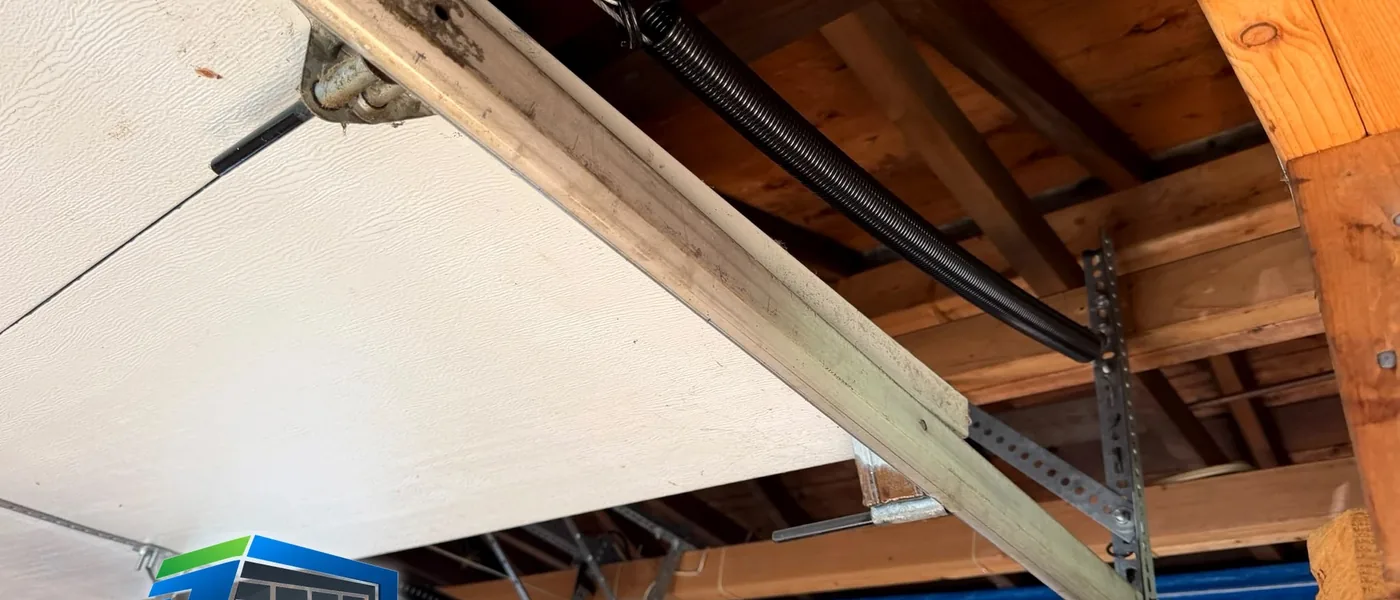
What happens during garage door spring replacement: securing the door
A broken spring leaves the door heavy and unbalanced, so the first job is making it safe. A technician typically makes sure the door is fully closed and resting on the floor.
The opener is unplugged or its power is cut so nobody can run it by accident. Locking clamps or vise grips usually go on the track just above a roller, so the door cannot move while the work is underway.
This is also why a homeowner should not try to lift the door or run the opener once a spring snaps. Without the spring, the full weight of the door is waiting to drop.
You can help before the technician arrives. Move cars out of the garage if the door is open and they can leave safely. Clear a path to the door and the area under the torsion bar, and keep children and pets inside the house.
Releasing the old spring's tension
Most doors in this area use torsion springs on a bar above the opening. Any tension left in them has to come out slowly and under control.
A technician does this with solid steel winding bars set into the spring's winding cone, unwinding it in small quarter turns. It is careful, deliberate work. Screwdrivers and other makeshift tools are a common cause of serious injuries, which is one reason spring work is not a DIY job.
Some older or lighter doors use extension springs instead. These run along the horizontal tracks on each side. They should have a safety cable running through the middle of each spring. If yours do not, mention it, because a broken extension spring without that cable can fly loose.
Either way, the principle is the same. All stored energy comes out of the system before parts are removed.
Removing the spring and checking the hardware
With the tension out, the old spring comes off the bar. This is a good moment to look at the parts around it, because a spring rarely fails alone.
- Lift cables are checked for fraying or broken strands.
- Cable drums are checked for wear and cracks.
- Center and end bearings are checked for roughness.
- Rollers and hinges are looked over for wear.
If a technician finds a worn cable or drum, ask to see it. It is easier to replace it now than to call again later.
Cable ends take a lot of stress at the bottom brackets. Rust and fraying there are common on doors that sit in damp conditions or get road salt splashed on them in winter.
Fitting, winding and balancing the new spring
New springs are matched to the door's weight and height. The spring is installed on the bar and wound a set number of turns for that door, again with winding bars.
Then the door is balanced. Lifted by hand to about halfway with the opener disconnected, a balanced door should stay roughly where it is. If it drifts up or falls, the tension needs fine-tuning.
On doors with two springs, the trade usually recommends replacing both at once. They have done the same work for the same years, so the second one is often close to failing too.
Spring size matters. A spring that is too weak leaves the opener doing the lifting. One that is too strong makes the door fly up and can keep it from staying closed. Wire size, length and inside diameter are chosen to suit the door.
Some homeowners ask about higher-cycle springs. These are built to last more open and close cycles than a standard spring, which helps on a door used many times a day. It is a fair question to ask during the visit.
Questions to ask before the work starts
A spring visit is a good time to ask questions. A technician should be glad to answer them.
- Is this a torsion or an extension spring system, and how many springs does my door have?
- Are you replacing one spring or both, and why?
- What spring size and cycle rating are you fitting?
- Did you find anything else worn, such as cables, drums or rollers?
- What does the warranty cover, and for how long?
Ask for the answers to be written on the invoice. It makes the next service easier, because the next technician will know exactly what was fitted and when.
If you are told the door needs more than springs, ask to see the part and why it matters. A clear reason you can see is what you are looking for.
Testing, and booking in Woburn
Last, the opener is reconnected. Force settings are checked and the safety reversal is tested, using the board test and the photo-eye test.
Johnny Garage Door Service offers garage door spring repair with a 90-day parts and labor warranty. The Woburn branch is at 6 Nichols St, Woburn, MA 01801, reachable at (339) 500-5426, and is open 24/7. The company has been in business since 2004 and holds Massachusetts Home Improvement Contractor license #217846.
You can read more about garage door repair in Woburn on our town page. Until help arrives, keep people and cars out from under the door.
After the visit, run the door a few times yourself. It should move smoothly and quietly, without jerking. Test the auto-reverse with a 2x4 laid flat under the door. If anything seems off, call back while the work is still under warranty.