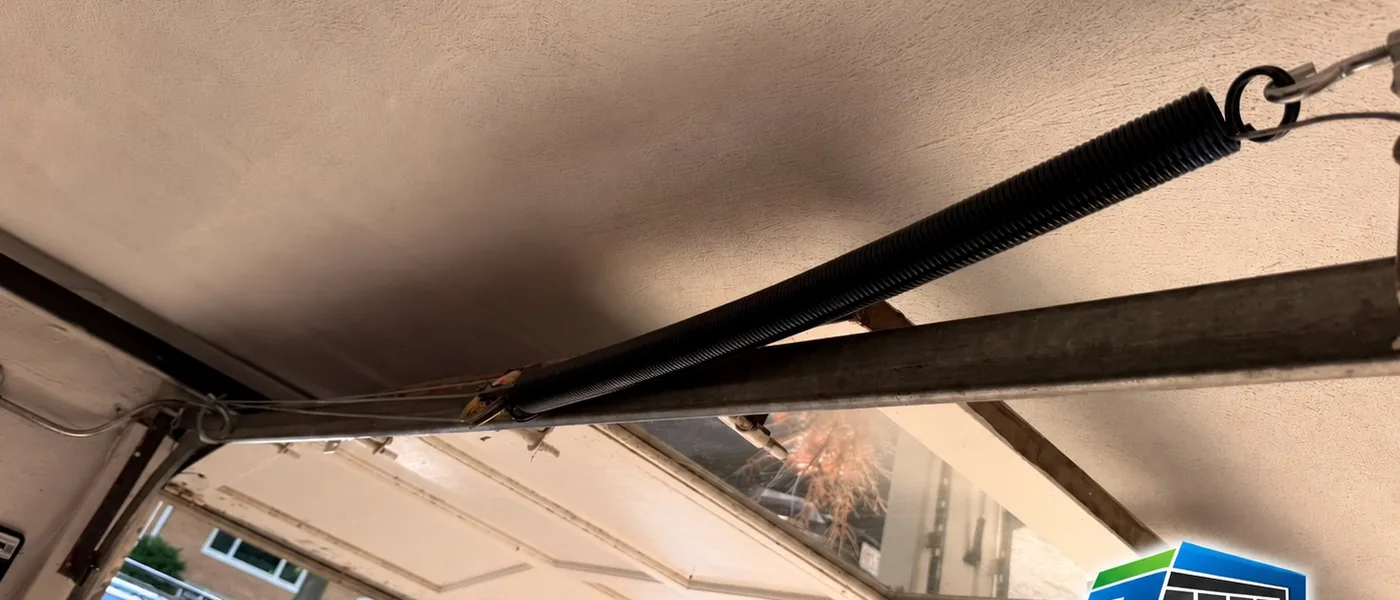
What garage door cables do
Lift cables are thin steel wire ropes that run from the bottom corners of the door up to the springs. On a torsion system they wrap around drums on a bar above the door. On an extension system they run through pulleys.
The springs do the lifting, but the cables carry that force to the door. If a cable fails, its side of the door loses support right away.
Because the cables are tied into the spring system, they are always under tension when the door is closed. That is the reason they need careful handling.
Most homeowners never think about their cables until one fails. That is understandable, since they are small, high up and easy to overlook. Knowing what they do and what a failing one looks like can help you stop using the door before a frayed cable turns into a snapped one, and before a crooked door does more damage to the track and panels.
Signs of a broken garage door cable
These are the symptoms technicians look for first.
- A crooked door. One side hangs lower, the door tilts as it moves, or it jams partway.
- A loose or hanging cable. Slack cable beside the door or wire unwound from a drum.
- Fraying. Broken strands sticking out, often near the drum at the top or the bracket at the bottom.
- Rust. Brown, rough patches that weaken the wire from the inside.
- A door that will not lift evenly or that the opener struggles with on one side.
Fraying and rust are early warnings. A cable can look a little rough for months before it lets go, so catching it at that stage is the best outcome.
Cables are also matched to the door. Their length and thickness are chosen for the door's height and weight. A cable that is too short, too long or too thin for the door will wear quickly or let the door sit unevenly. That is one reason a replacement should be sized to the door rather than grabbed off a shelf.
Why cables wear out
Cables flex every time the door moves. Over thousands of cycles the strands fatigue and start to break one by one.
Moisture is a big factor. The bottom of the door sits near puddles, snowmelt and road salt. That is where rust often starts, at the bottom bracket.
A cable that rubs against a drum edge, a bent track or a misaligned pulley also wears faster. And if a spring is out of balance, one cable may carry more than its share.
Cable failure or spring failure?
The two problems can look alike, but there are some clear differences.
A broken cable usually leaves the door crooked. You may see a cable hanging loose and the door tilted in the opening. The door may still move, but unevenly.
A broken torsion spring usually announces itself with a loud bang. Afterward the door often sits level but feels extremely heavy, and it may not lift more than a few inches.
Sometimes one causes the other. A spring that breaks can throw a cable off its drum, and a snapped cable can unbalance the door enough to strain the spring. Either way, the fix belongs to a technician.
How to look at your cables safely
You do not need to touch a cable to inspect it. With the door closed, stand back and look up at each side of the door. Follow the cable from the bottom bracket up to the drum or pulley.
A healthy cable looks smooth and evenly wound. It should sit snugly in the grooves of the drum, with no loose loops or crossed wraps. Both sides should look about the same.
Then look at the bottom brackets where the cables attach. Rust there is worth noting, because it weakens the bracket and the cable end together. A flashlight helps, especially in a dim garage.
Listen too. A cable that is slipping on its drum can make a snapping or scraping sound as the door moves. A door that suddenly jerks or shudders partway up is also worth a closer look.
If anything looks wrong, take a photo from where you stand. It helps a technician understand the problem before arriving, and it keeps your hands well away from the hardware.
Try to check the cables a few times a year, and after any hard winter. Salt and snowmelt sit at the base of the door for months, and that is where the trouble usually starts.
What to do if you see these signs
Stop using the door. Switch off or unplug the opener so nobody tries to run it. Keep people and pets away, and do not park under a door that is hanging crooked.
Do not try to tighten, rewind or remove a cable yourself. The cables are under spring tension, and a slipping cable or drum can cut hands and cause serious injury. Leave the bottom brackets alone too.
Most technicians replace cables in pairs, since both have aged at the same rate. They will also check the drums, springs and track for whatever caused the failure.
Johnny Garage Door Service provides garage door cable replacement 24/7, backed by a 90-day parts and labor warranty. If your door is crooked or a cable is hanging, call and leave the door where it is.