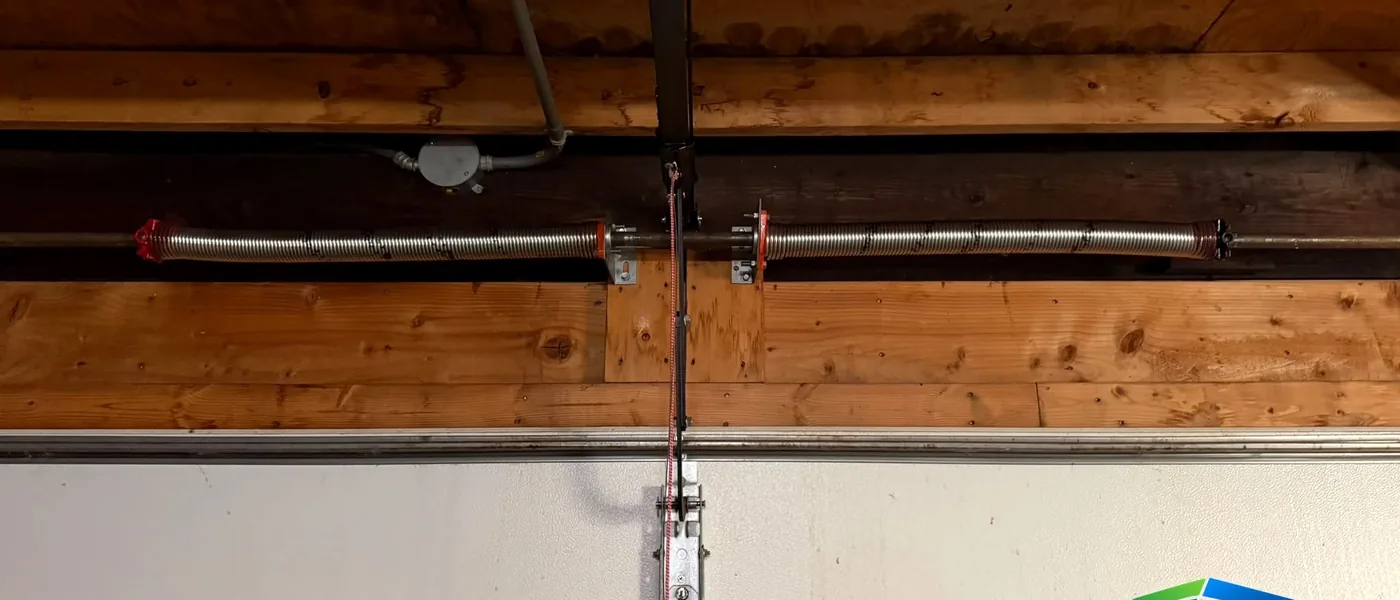
How long do garage door springs last in cycles?
Spring makers do not rate their springs in years. They rate them in cycles. One cycle is the door going up once and coming back down once.
A typical torsion spring on a home garage door is built for about 10,000 cycles. That number is a design target, not a promise. Some springs fail a little early and some keep going past it.
For an average household, 10,000 cycles works out to somewhere around 7 to 12 years. That wide range is the reason two neighbors with the same door can see their springs break years apart.
Extension springs, the long springs that stretch along the horizontal tracks on some older doors, follow the same idea. They also wear out by use, and they also tend to give little warning before they let go.
Do the math for your own door
You can estimate your own spring life with simple division. Take the rated cycles and divide by how many cycles your household uses in a year.
Say your family opens and closes the door four times a day. That is about 1,460 cycles a year. A 10,000 cycle spring would last close to seven years at that pace.
Now picture a home where the garage is the main entrance. Kids leave for school, someone runs errands, a teenager comes and goes. Ten cycles a day is not unusual there. At that rate the same spring could be done in under three years.
A door that only moves twice a day might stretch past a decade. Nothing is wrong with the spring in either case. It is simply being used at a different rate.
- 2 cycles a day: about 13 years on a 10,000 cycle spring
- 4 cycles a day: about 7 years
- 8 cycles a day: about 3 to 4 years
High-cycle springs and what else shortens spring life
If your door gets heavy use, high-cycle springs are worth asking about. These are made with heavier wire and longer bodies, and they are commonly rated for 25,000 to 50,000 cycles. They cost more up front but can outlast standard springs by many years on a busy door.
Use is not the only thing that wears a spring. Moisture plays a big part. Humid garages and damp New England winters let rust form on the coils. Rust adds friction between the coils and creates weak spots in the steel, and a spring tends to snap at its weakest point.
Door weight matters too. A spring sized for a lighter door will be overworked if a heavier door, added insulation or a new window section is fitted without matching the springs.
Simple care helps. A light coat of garage door lubricant on the coils a couple of times a year can slow rust and quiet the door. Wipe it on from a safe distance and never try to adjust, loosen or unwind a spring. Spring work is for a trained technician.
Warning signs a spring is near the end
Springs often break without much notice, but there are a few clues worth watching for.
- The door feels heavy or the opener strains and slows down
- The door rises unevenly or one side leads the other
- A visible gap has opened between coils on a torsion spring
- Coils look rusty, stretched or out of shape
- A loud bang from the garage, often followed by a door that will not lift
A loud bang is the classic sign. Torsion springs store a lot of energy, and when one breaks it releases with a sound like a gunshot. After that the door may only lift a few inches or not at all.
If you see any of these signs, stop using the door and keep everyone clear of it. Do not pull the emergency release on a door with a broken spring, because the door can drop fast.
Torsion and extension springs age differently
Torsion springs sit on a steel bar above the door and twist to store energy. Extension springs stretch along the tracks. Both are rated by cycles, but they fail in different ways.
A torsion spring usually breaks cleanly at one point in the coil. An extension spring can stretch out of shape first, which makes the door feel heavier for a while before anything snaps. Older extension systems should also have a safety cable running through each spring, so a broken spring does not fly across the garage.
Cold weather adds stress to both types. Steel gets more brittle as temperatures drop, and many springs that were already worn give out on the first hard freeze of the season.
When to replace your garage door springs
Many technicians suggest replacing both springs together on a two spring door. They were installed at the same time and have done the same number of cycles. If one has failed, the other is usually close behind.
Replacement is also a good time to think about cycle rating. If your household uses the door a lot, a higher cycle spring may save you a second service call a few years from now.
Spring replacement involves wound steel under heavy tension, so it is not a do it yourself job. Johnny Garage Door Service handles garage door spring repair around the clock, 24/7, and the work carries a 90-day parts and labor warranty. If your spring has broken or is showing the signs above, give us a call.