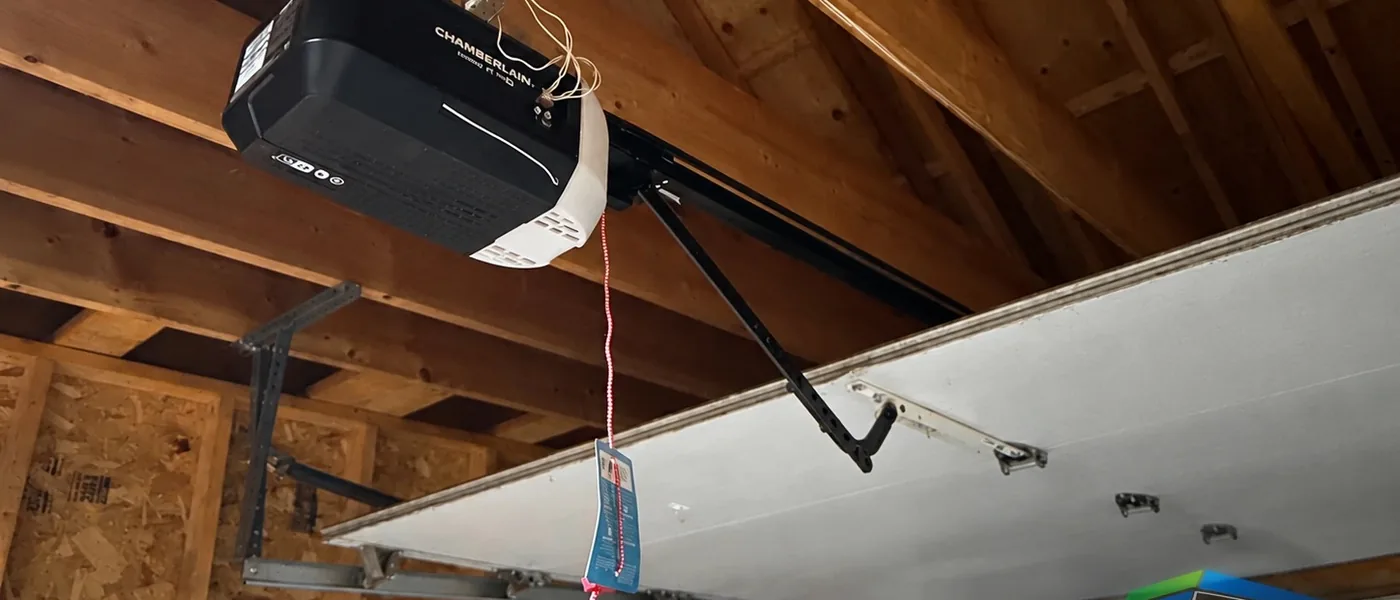
How to choose a garage door opener by drive type
The drive is how the motor moves the door. Each type has its own strengths.
- Belt drive uses a reinforced rubber belt. It is the quietest choice, which suits a garage under a bedroom.
- Chain drive uses a metal chain. It is louder but durable and usually the lowest cost.
- Screw drive turns a threaded rod. It has few moving parts, but some models are sensitive to big temperature swings.
- Wall-mount or jackshaft openers sit beside the door on the torsion bar. They free up the ceiling and work well for low ceilings and high-lift doors.
Cold winters are worth thinking about here. Ask how a model handles low temperatures before you buy.
Noise is often the deciding factor. If you have a bedroom or a home office over the garage, the difference between a chain and a belt is easy to hear. If the garage is detached, a chain drive may be all you need.
Match horsepower to the door
A typical single steel door is well served by about a half horsepower opener. Heavier doors, such as solid wood, insulated double doors or doors with lots of glass, generally call for three quarters horsepower or more.
More power is not a fix for a bad door, though. The springs do the lifting. The opener only guides a door that is already balanced.
Many newer openers use DC motors. These tend to start and stop more softly, run more quietly and often pair well with battery backup. AC motors are the long-standing standard and are usually simple and dependable.
Ask how the opener's rating was measured. Some brands list a horsepower equivalent rather than a true motor rating, so compare lifting capacity where you can.
Check your ceiling clearance
Ceiling-mounted trolley openers need room above the door's highest point when it is open. Most need roughly 12 to 18 inches, depending on the model.
Measure from the top of the open door to the ceiling before you shop. If the space is tight, or if ductwork or storage is in the way, a wall-mount opener may be the better fit.
Also check the length of the rail. Standard rails suit a seven foot door. A taller door, such as eight feet, usually needs an extension kit or a longer rail. A wall-mount opener avoids the rail question entirely.
Security and backup power
Look for rolling-code technology, which changes the remote's code each time it is used. It makes it far harder for someone to capture and copy your signal.
Battery backup is also worth having. During a power outage it lets you open and close the door several times, which matters when the car is inside and the storm is outside.
Smart openers add a phone app, and some include a built-in camera so you can see the garage. Extra remotes and an outdoor keypad round out the setup.
Think about how your household uses the garage. If it is the main entry, a keypad saves fumbling for keys. If teenagers come and go, a smart app that shows whether the door is open can save a trip back home.
Check that any smart opener you consider works with your home Wi-Fi in the garage. Signal can be weak through block or brick walls.
A quick checklist before you buy
Before you settle on a model, walk out to the garage with a tape measure and run through these points.
- Measure from the top of the open door to the ceiling.
- Note the door's height and whether it is single or double width.
- Check the door's material and whether it is insulated, which affects weight.
- Look for an outlet near where the motor will hang.
- Lift the door by hand with the opener disconnected and note whether it stays put.
- Count how many remotes you need and whether you want a keypad outside.
With those answers in hand, choosing between drive types and features becomes much simpler. You will also be ready to answer the installer's questions, which helps the job go smoothly.
If the door does not stay put when lifted, leave it as it is. Spring adjustment is a job for a technician, not a weekend task.
Safety first, and installation in Woburn
Every new opener should have working photo-eye sensors and contact reversal. Before installing it, the door itself should be checked. A door with worn springs or binding rollers will strain a new opener and shorten its life.
Johnny Garage Door Service handles garage door opener installation, including smart openers with a camera, remotes and keypads. Work is covered by a 90-day parts and labor warranty, and the company has been in business since 2004.
For local details, see our page on garage door repair in Woburn. The Woburn branch is at 6 Nichols St and answers at (339) 500-5426, 24/7.
If you are replacing an old opener, ask the installer to test the door's balance before the new one goes up. Lift the door by hand to waist height with the opener disconnected. It should stay roughly in place. If it falls or climbs, the springs need attention first, and that is a job for a technician.